
Key points:
- Employers and universities benchmark Gen Z preferences against their own talent, recruitment, and engagement strategies
- Preparing students for global careers
- Nearly half of high school students now use AI in college search
- For more on Gen Z’s career views, visit eSN’s Innovative Teaching hub
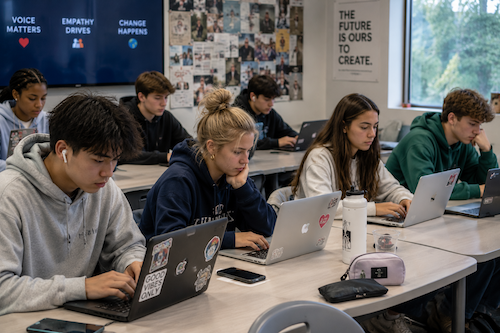
There’s never been a more turbulent time for young people to plan for and embark on their futures, and a new survey gives insights on their feelings and plans.
The new 2026 Career Interest Survey of 11,443 Gen Z students, conducted by National Society of High School Scholars (NSHSS), gives insights into what motivates a vocal, community-focused, tech-savvy emerging workforce. This new data set is part of a bi-annual survey that indicates trends over the past several years.
Students are confident, despite concerns:
- Nearly all (94 percent) are extremely, very, or somewhat confident about their future after graduating college.
- Eighty-four percent believe they can personally make a difference in the world.
- Human rights is their #1 societal issue, followed by equitable access to healthcare and poverty/hunger.
- Seventy-nine ercent plan to have a job secured prior to graduating or within six months of graduation.
AI use is universal–and complicated:
- The percentage of students “not using AI at all” decreased from 36 percent in 2024 to 6 percent in 2026. Half (49 percent) use it on a daily or weekly basis.
- The majority say that AI will have a more negative than positive impact on society, with that sentiment jumping from 59 percent in 2024 to 69 percent in 2026.
- Virtually all (91 percent) think AI will negatively impact their privacy and security in the next 10 years.
- AI is rapidly replacing search engines, with 55 percent of respondents using it to search for information on the internet.
Employers, take note: Students know what they want:
- When asked what benefits matter most, annual salary comes in last (49 percent). Health benefits (72 percent) are the most important, with time off and flexible work schedule tying at 62 percent.
- Anticipated job turnover for this group is high: more than half (56 percent) expect to stay in their first job for two years or less.
- When considering a job, fair treatment of allemployees ranks #1, followed by work life balance and corporate social responsibility.
- They care the most about gaining skills and professional development (66 percent), followed by work/life balance (47 percent), and positive workplace culture (38 percent).
- Job location is not a big consideration. Those ranking job location least important (#7) increased from 6 percent in 2024 to 21 percent in 2026.
- Fifty-one percent of respondents would take a job with an organization that does not align with their political beliefs.
Other findings
- Scholarships are a dominant force in paying for college, ranking #1 at nearly half (49 percent), followed by family contribution (14 percent) and high school/college jobs (13 percent).
- The top career fields of interest are engineering (17 percent), sciences (16 percent), medicine/health services (15 percent).
- Fifty-two percent would go down a career path that guarantees financial success but doesn’t appeal to them.
- The percentage of students who expect to live at home for their first job has increased, from 60 percent in 2022 to 68 percent in 2026.
- Respondents are largely monolingual: 70 percent are not fluent in any language besides English.

eSchool Media staff cover education technology in all its aspects–from legislation and litigation, to best practices, to lessons learned and new products. First published in March of 1998 as a monthly print and digital newspaper, eSchool Media provides the news and information necessary to help K-20 decision-makers successfully use technology and innovation to transform schools and colleges and achieve their educational goals.
Latest posts by Teach Strats Staff (see all)
- Despite concerns, Gen Z students are optimistic about AI - May 20, 2026
- In Illinois, charting a path for responsible AI use - May 14, 2026
- In a new survey, AI scores high as a math learning tool - May 12, 2026