
The COVID-19 pandemic has certainly thrown education for a loop. Even as classes resumed this past fall, many districts implemented widespread student and teacher quarantines and shifted to virtual learning as new outbreaks and variants emerged.
What new tools, techniques, and innovations should stick around in primary schools even after COVID recedes (whenever that may be)?
Check out this Teach Strats webinar and learn from veteran educators who recall their work-around strategies during the massive shift to remote learning. They’ll provide valuable insight and will suggest which tools and strategies should be kept to create new hybrid learning models for younger students.

- In districts, reaching readiness, retention, and success - March 5, 2026
- AI use is on the rise, but is guidance keeping pace? - January 2, 2026
- 49 predictions about edtech, innovation, and–yes–AI in 2026 - January 1, 2026
More from Teach Strats

We can’t punish our way out of the attendance crisis
In the Ithaca City School District, we have long understood that relationships are not peripheral to the work; they are the work. A culture of love is not aspirational language but a daily commitment to ensure that every student, every family, and every member of our community feels seen, valued, and connected to something greater than themselves.
In a new survey, AI scores high as a math learning tool
AI plays a supportive educational role for nearly 70 percent of top-performing math students asked about their study habits, according to a new survey.

What higher ed can do about getting research into the K-12 classroom
Educational research has never been more abundant, yet its impact on classroom practice remains uneven at best. While universities continue to produce studies on instructional strategies, student outcomes, and emerging technologies, many K-12 educators rarely engage with this work in meaningful ways.

This elementary school banned screens in the middle of the year. Will it solve their reading crisis?
Last month, Mesick Consolidated Schools banned digital devices in its elementary school of about 250 students. The decision wasn’t an agonizing one. The ban came at astonishing speed, almost overnight, after a conversation between Mesick Superintendent Jack Ledford and Jewett Principal Elizabeth Kastl.
Oracy is the missing link for multilingual learners
For multilingual learners, language is not just a subject to be learned–it is the very medium through which they access the curriculum.
Why so many students struggle in math before learning even begins
In mathematics education, we have long relied on a familiar sequence: introduce vocabulary, demonstrate procedures, and assign practice. For some students, this works well enough.
When AI means something different in every classroom
In many schools, AI is being handled through individual teacher decisions rather than a shared structure. That makes sense in the short term. Teachers are responding in real time, trying to protect their classrooms, their expectations, and their students.
What it takes to build teacher confidence in math: 4 lessons for district leaders
After 20 years teaching high school math, I thought I understood why students struggled. Then I sat in my first professional learning session focused on early math and was humbled.
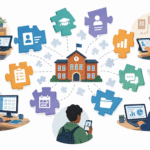
The hidden cost of fragmented student data in K–12 schools
In many K–12 schools today, fragmented student data has quietly become one of the most significant barriers to effective decision-making and day-to-day operations. While digital tools have expanded rapidly in classrooms and administrative offices, the systems managing student information, communication, and reporting often remain disconnected.

The 4 keys to creating meaningful student-led inquiry
Does the thought of student-led inquiry make you nervous? For some teachers, handing over control of the classroom to their students sounds like an invitation for disaster.