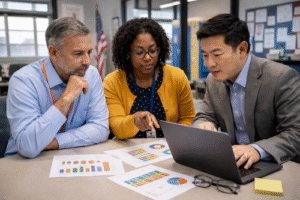
See how Arlington SD centralized evaluations, SLOs, documentation, and reporting in one place — saving time while improving collaboration, visibility, ... Read more
In the Ithaca City School District, we have long understood that relationships are not peripheral to the work; they are the work. A culture of love is not…
The world of work is changing fast. Careers no longer sit neatly within a single industry, city, or even country; they span disciplines, time zones, technologies, and cultures.
District leaders across the country are grappling with a deepening crisis: Student mental and behavioral health needs are growing more complex. In a recent national survey, 58 percent…
When Senator Bill Cassidy recently questioned whether K–12 systems are adequately preparing students for college-level math, he touched a nerve in the national conversation.
Data has become one of the most important strategic assets in education. Yet across institutions, publishers, and edtech companies, it often remains fragmented, inconsistently governed, and difficult to…
Microschools are small learning environments that typically serve a limited number of students and emphasize personalization and strong relationships. Often blending elements of traditional schooling, project-based learning, and…
School buildings quietly shape everything that happens inside them. When systems work as intended, learning moves forward uninterrupted. When they fail, instruction, safety, and trust can unravel quickly.
As K-12 schools prepare for 2026, edtech and innovation are no longer driven by novelty--it’s driven by necessity. District leaders are navigating tighter budgets, shifting enrollment, rising cybersecurity…
If you’ve attended a professional show or musical recently, chances are you’ve seen virtual set design in action. This approach to stage production has gained so much traction…
A revolution quietly underway in American education: the rise of homeschooling. In the past decade, there’s been a 61 percent increase in homeschool students across the United States,…
How can we make classroom learning more meaningful for our students? In today’s rapidly evolving world, preparing learners for the future isn’t about gathering academic knowledge.
You’ll often hear two words come up in advising sessions as students look ahead to college: match and fit. They sound interchangeable, but they’re not.
Recent policy shifts have caused significant uncertainty in K-12 education funding, especially for technology initiatives. It’s no longer business as usual. Schools can’t rely on the same federal…
For nearly two decades, I’ve worked to improve teaching and learning with technology. And while the continuously evolving nature of technology has changed the trajectory of my career…
Invest in your students’ futures with MackinVision. This new school library resource management tool delivers intuitive browsing, secure access, ... Read more
At ISTE this summer, I lost count of how many times I heard "AI" as the answer to every educational challenge imaginable. Student engagement? AI-powered personalization!
At Clearfield Elementary, increasing reading engagement wasn’t just about books—it was about improving student attendance and creating a culture that ... Read more
Students need more support around education paths and career options, including hands-on experiences, according to a new nationwide survey from the nonprofit American Student Assistance.
LG Electronics USA, the edtech innovator behind the Google EDLA-certified LG CreateBoard interactive display, is once again raising the bar ... Read more
When—Tuesday, July 1, 12:30 – 1:30 p.m.HBGCC – Mainstage Think Big Series: The Invisible Currency: Social Capital and the Future of Career-Connected Learning ... Read more
In education, we talk a lot about equity, personalization, and meeting students where they are. But we often ignore one fundamental truth: Learning takes time, and the time…
Abraham Maslow’s Hierarchy of Needs is a fundamental psychological theory that explains human motivation. At its base are physiological and safety needs, followed by love and belonging, esteem,…
The adverse effects of this excessive screen time have significantly impacted students’ social- emotional health. Forty-one percent of teens with the highest social media usage struggle with mental health issues.
Fifty-nine percent of students say they would like more opportunities for career-connected learning, according to a new report from the New Hampshire Learning Initiative and Gallup.
BEAVERTON, Oregon — Connected by a shared commitment to hands-on science education and customer service, Vernier Science Education is partnering ... Read more
BOSTON — Adaptive learning company HMH today announced the launch of HMH Coachly™, an innovative service that provides educators with unlimited access to ... Read more
Imagine a school where learning isn't confined to the classroom. The curriculum is adaptive in real-time, and technology is used intuitively to ensure every aspect of student life…
There’s a new pillar of knowledge school districts need to impart upon their students, and it’s how to navigate today’s connected, digitally enabled world.
Schools and districts nationwide are learning that effective communication with families is more important than ever before. Unfortunately, developing a communications plan is time- and resource-intensive, especially if…
CTL, a global cloud-computing solution leader for education, will present at the upcoming Consortium for School Networking (CoSN) conference in Miami, Florida, on Tuesday, ... Read more
When the Federal Communications Commission’s E-rate program first emerged in 1996, only 14 percent of the nation's K-12 classrooms were connected to the internet.
Bringing public science learning beyond its onsite exhibits and programs, the Museum of Science, Boston has launched a collection of preK-8 engineering and STEM curricula designed to engage…